


Remember the 2025 AI for Humanity Report? We’re kicking off research for the 2026 installation and would love your organization’s perspective. If you’re a nonprofit that uses AI, fill out the survey interest form. And grantmakers, please forward it to your grantees.
Last month, India hosted the AI Impact Summit in New Delhi. If you followed the online coverage, you might think the main takeaway involved a certain CEO duo’s very public refusal to hold hands. Fair enough. But that was hardly the real story.
India may be one of the most important places in the world to look to to understand whether AI can actually work for humanity. Three of my Fast Forward colleagues and several founders in our portfolio made the journey to the Summit and came back with a lot to say.
“The first thing that struck me walking into the AI Impact Summit in New Delhi was how overdue it felt,” said Manu Chopra, co-founder of Karya. “For years, many of the most important conversations about AI have taken place in Silicon Valley. This time, the conversation had come to India.”
Nearly 600K people attended in person; another 900K joined virtually. The range of perspectives in the room was striking — frontier AI researchers sitting alongside AI-powered nonprofit leaders working on agriculture, labor, public services, and language access.
India combines massive population scale, extraordinary linguistic diversity, fast-growing digital infrastructure, and no shortage of real-world need. In other words, if you want to know whether AI can be useful, inclusive, and grounded in everyday life, this is a pretty good place to look.
Here are three reasons we should all be paying closer attention.
1. India’s Running Start
To understand part of why India matters for AI, you have to understand what India has already built. Manu helped illustrate it with the following example:
Consider something as ordinary as paying for a cup of tea. In many parts of the world, paying with a phone means services like Apple Pay or Venmo, tools built by private companies and largely designed for people who already had access to banking. Across India, however, it is common to see a QR code beside a cash register or on a street vendor’s cart. A quick scan from a phone and the payment is complete. Behind that QR code sits UPI, the Unified Payments Interface, a real-time payments network built as public infrastructure. Today, UPI processes more than 20B transactions each month, handling more daily transactions than global card networks like Visa and Mastercard.
UPI works alongside Aadhaar, India’s national digital identity system, which now covers more than 1.3B people and enables residents to verify their identity when accessing services ranging from banking to government benefits. Together these systems form a layer of digital public infrastructure supporting financial services, public programs, and everyday economic activity.
This digital ecosystem is the reason AI can spread in India in ways it simply cannot elsewhere. The infrastructure enabling payments and identity is the same infrastructure that can carry AI tools to people who want to translate a message, ask a health question, or seek agricultural advice.
“Long term, it’s good for the world that AI is not just viewed as a race between the U.S. and China, and I think that India is right now the player that most confidently says, ‘We reject this dynamic.’”- Jakob Mökander, Director of Science and Technology Policy at the Tony Blair Institute for Global Change, in NBC News
2. A Pressure Test for Inclusion
India has hundreds of languages, thousands of dialects, and nearly 200 endangered ones. AI systems trained mostly on English run straight into this reality. Ask one for breakfast recommendations in Marathi and you might get a perfectly fluent recipe for avocado toast: correct language, wrong context.
“AI systems recognize the worlds that appear in their data,” Manu says. “Entire ways of living remain invisible if they’re never documented.”
That invisibility has a human cost. If AI only understands the world as it appears in English-language data, it will only be useful to the people whose lives are reflected there. Everyone else gets a system that was never really built for them.
Manu founded Karya to change that, and they’re doing it in a way that addresses two challenges at once. The platform pays workers across rural India to complete digital tasks in their mother tongues — translating sentences, recording audio, labeling images, evaluating models — in languages that had almost no digital presence until now. That work builds richer, more contextually grounded data for AI systems. It also creates dignified, fairly paid work for communities that have historically been locked out of the modern economy. Workers own their data and earn royalties whenever it’s used. To date, 150K Karya workers have built foundational language datasets for 70+ Indian languages.
India’s linguistic diversity makes it one of the hardest places in the world to build AI that actually works at scale. That’s exactly what makes it worth watching. Per the sentiment shared in last month’s newsletter, “Build for the margins and the center will follow.” If India can get AI right at the edges, across dialects, across vastly different lived realities, we have a much better shot at getting it right everywhere else too.
3. Built for the People, By the People
Representation in data is step one. Building around real lives and local contexts is step two. India has an unusually dense ecosystem of organizations doing exactly that. Part of that may come from India’s corporate social responsibility requirements, which mandate that qualifying companies spend at least 2% of average net profits on social good. That doesn’t automatically produce great nonprofits, but it does help create the conditions for more of them to exist.
Our team saw this up close during site visits with two Fast Forward portfolio organizations working in very different sectors, both built around deep local context.
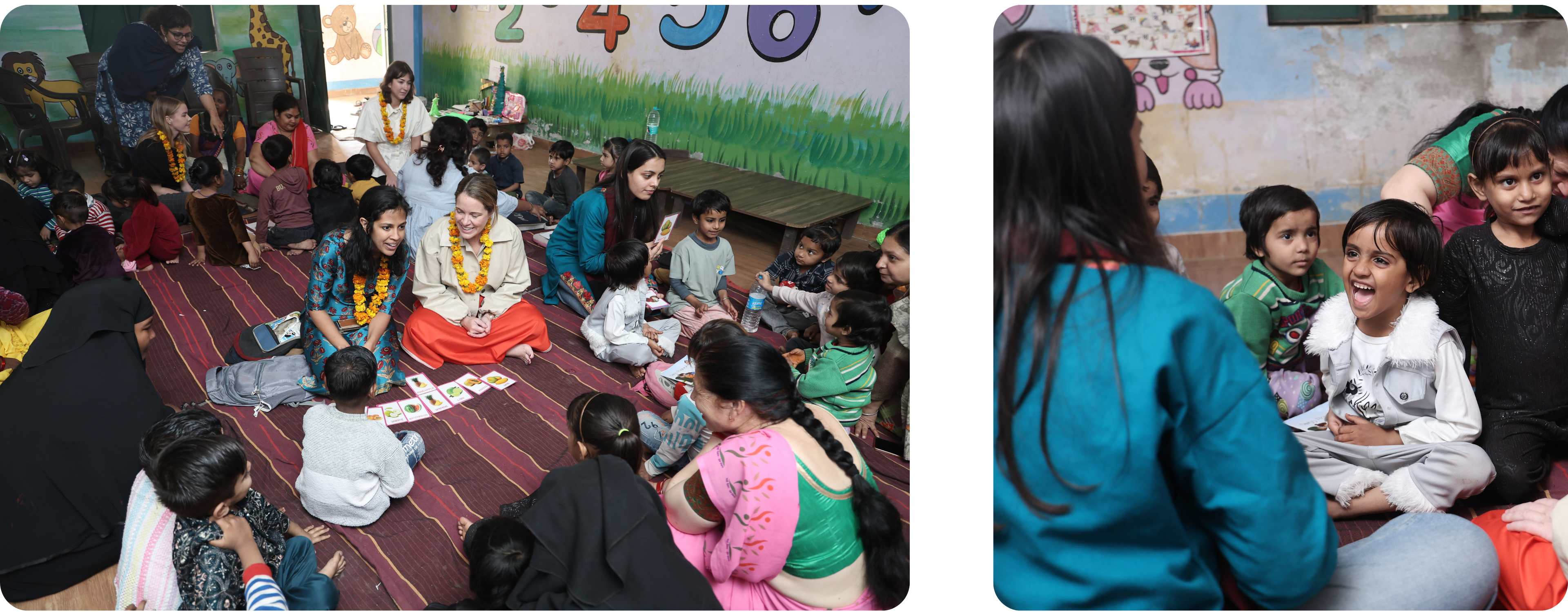
The first stop was with Rocket Learning at an Anganwadi, a government-supported early childhood center. India’s Anganwadi network is the largest community-led childcare system in the world, with 1.4M centers serving 50M children aged 3 to 6. Historically these centers focused on basics: nutrition, simple numbers, the alphabet. Meanwhile, research consistently shows that the years before age six are among the most critical for cognitive and emotional development. Anganwadi educators wanted to do more. They just didn’t have the tools.
Rocket Learning gave them some: play-based learning exercises led through the centers, an AI co-pilot to help educators build activities tailored to their kids, and short exercises sent to parents’ phones to continue at home. Critically, parents aren’t just recipients. Rocket Learning works directly with them to refine and improve the product, making sure what gets built actually reflects what families need. The mothers our team spoke with said their children were becoming more talkative, more emotionally regulated, more curious. Today, Rocket Learning works with 400K Anganwadi educators and 5M parents and children across India.
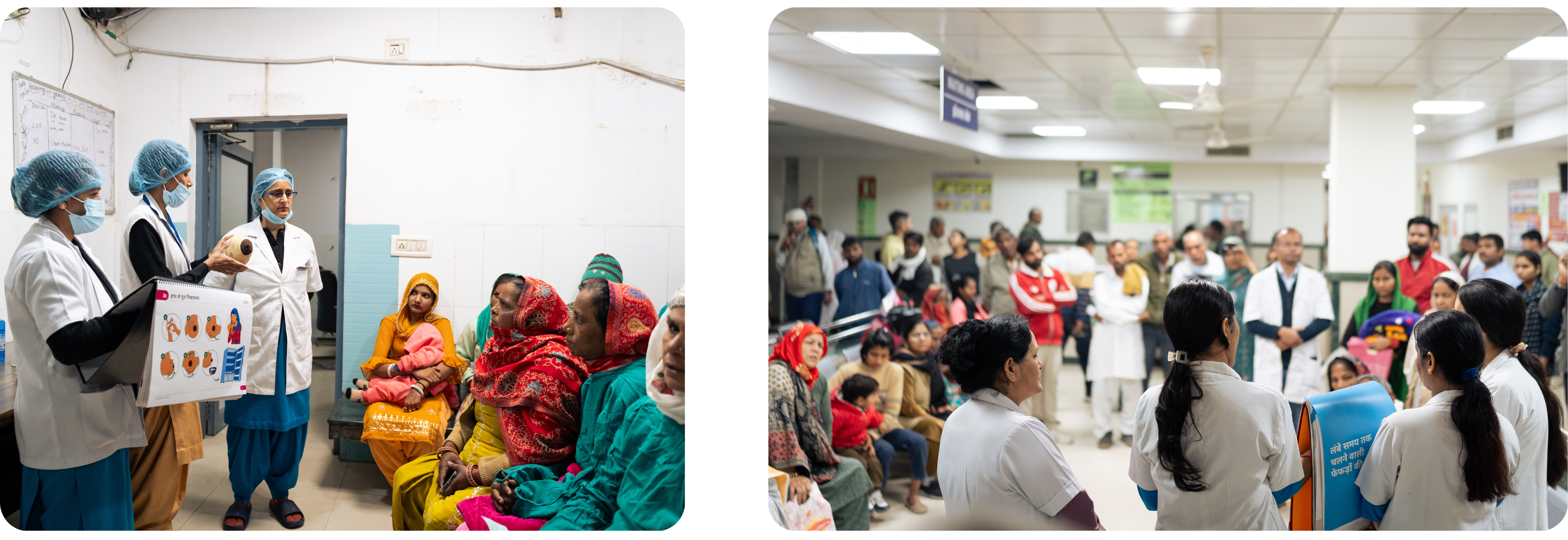
The second stop was with Noora Health at a hospital in Rohtak, where the problem looked different but the principle was the same. Family members play an enormous role in patient care, often stepping in where understaffed healthcare systems cannot. Yet those same family members rarely receive any formal training or guidance. They leave facilities anxious, confused, and ill-equipped, leading to preventable complications.
Noora Health treats caregiver education as a fundamental part of healthcare itself and delivers it in the language, format, and cultural context that resonates with the people receiving it. Their Care Companion Program is built through genuine co-creation: healthcare workers, nurses, patients, and family members all shape the educational materials, which are then prototyped and tested in real-world settings before full deployment. Our team saw nurses running ten sessions a day, sharing evidence-based practices with family caregivers and adapting to the realities of the community right outside the hospital doors. Once caregivers return home, mobile messaging continues the training and support, extending guidance beyond the hospital walls. An AI co-pilot also supports healthcare workers by helping triage questions and providing response support.
Both models work for the same reason: they meet people where they already are — already gathered, already motivated, already present.
A Funding Ecosystem Takes Root
The energy we saw at the AI Impact Summit wasn’t just about tech; it was also about the capital mobilizing behind it. At the Google.org Impact Summit APAC, held alongside the main event, we watched philanthropy leaders from across the region gather to rethink how funding flows to AI for good.
The announcements reflected that momentum. Google.org announced a $30M AI for Government Innovation Impact Challenge and a $30M AI for Science Impact Challenge. Google DeepMind launched a new partnership with Indian government bodies to unlock discoveries in science and education. According to Fortune, the entire India AI Impact Summit generated a wave of major investment commitments in the country, with Electronics Minister Ashwini Vaishnaw saying over $200B in AI and deep-tech investment is expected in the country over the next two years.
As Maggie Johnson, VP and Global Head of Google.org, noted during the Summit: “The problems we’re working on are so big that no one organization can solve them alone.” India is showing how the ecosystem — builders, funders, frontline workers, and government — can move together.
Quick Bytes
Other Sector Stories
Grantmakers: you asked, we answered. Fast Forward gathered all of our tools for AI grantmaking in an aptly named Tools for AI Grantmaking hub. Whether you are exploring AI for the first time or already investing in AI grantees, these resources are meant to help you move from inspiration to action.
OpenAI Foundation pledged to grant out $1B over the next year to ensure AI “benefits all of humanity” — a major increase from its recent grantmaking, which had dwindled to $3.3M annually after going for-profit. The funding will support life sciences, health research, and efforts to mitigate AI’s impact on jobs and mental health. The question, as Vox notes, is whether mission-driven philanthropy can truly coexist with a company fighting to dominate the AI industry.
APN Opportunities and Funding News
Multilingual by Design will pair nonprofits with deep expertise in multilingual education with AI builders to co-design new tools for K-8 math and literacy. Apply by April 3, 2026.
Google.org announced the $30M Google.org Impact Challenge: AI for Government Innovation. Apply by April 3, 2026.
Applications are also open for the $30M Google.org Impact Challenge: AI for Science. Apply by April 17.
For weekly funding updates for your AI-powered nonprofit, subscribe to Funding Forward.
Let’s Talk
I am living and breathing AI for humanity these days. If you are too, drop a comment!
Link Library
The Karya model stands out to me as genuinely novel — workers owning their data and earning royalties creates an incentive structure that most data collection projects don't even attempt. The point about AI invisibility hitting communities whose lives aren't in the training data is something Indian policymakers need to take seriously as adoption scales. The UPI/Aadhaar infrastructure angle is also underappreciated globally — that kind of digital public infrastructure is what makes grassroots AI deployment tractable in a way it simply isn't in countries that skipped that layer.
What I keep coming back to in conversations around AI is that the deepest uncertainty often seems less technological than human.
We are not only adapting to new tools, but to the possibility that many roles, skills, and identities we built ourselves around may fundamentally change.
The challenge may not simply be economic. It may also be psychological: how people maintain meaning, self-worth, and inner stability during periods of rapid transformation.